
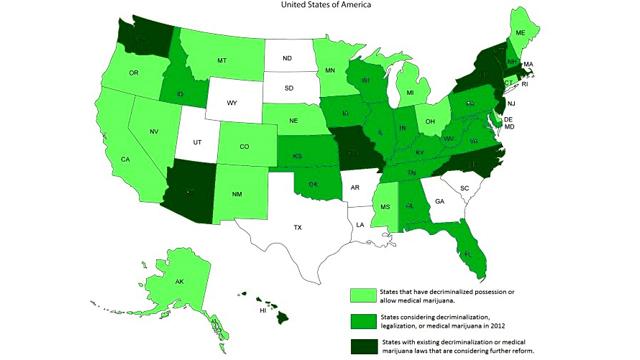
As we approach November, the leading Democrat and Republican presidential candidates remain conspicuously, though predictably, silent regarding the question of marijuana law reform. By contrast, much of the public and the mainstream media can’t stop talking about pot politics. That’s because voters in six states this November 6 will have their say on the subject. If present polls hold, federal officials on November 7 will have little choice but to acknowledge that they have a full fledged reefer rebellion on their hands.
Voters’ impending rejection of the drug war status quo shouldn’t come as a surprise, at least not to anyone who has been paying attention. Opinion polls over the past 12 months indicate record levels of public support for ending America’s multi-decade failed experiment with cannabis criminalization. Are a majority of Americans finally ready to voice their drug war dissent at the ballot box? In mere weeks, voters in six states will have the opportunity.
Arkansas
For the first time ever, voters in the southeastern United States will have the opportunity to strike a significant blow to decades of reefer madness. On November 6, Arkansas voters will take to the polls to decide on Issue 5: the Arkansas Medical Marijuana Act.
The Act eliminates statewide criminal and civil penalties regarding the physician-recommended use and possession of up to two and one-half ounces cannabis for patients diagnosed with various qualifying medical conditions, including cancer, Crohn's disease, fibromyalgia, hepatitis C, and post-traumatic stress disorder (PTSD). The measure also allows state regulators to establish not-for-profit facilities to produce and dispense cannabis to those with their doctor’s approval. Individuals will also be permitted to privately cultivate limited amounts of cannabis (up to six flowering plants) if they reside further than five miles from a state-authorized dispensary. (You can read the full text of the initiative here).
While no recent statewide polling is publicly available regarding this measure, nationwide surveys estimate that between 65 percent and 75 percent of the American public are in favor of allowing qualified patients access to cannabis. Historically, this support has translated to victory at the ballot box. Of the 17 states that allow for the limited use of therapeutic cannabis, 11 did so by voter initiative. (Voters in Arizona, Maine and Nevada have voted on two separate occasions in favor of allowing access to medicinal cannabis.) Voters in the District of Columbia also took to the polls in overwhelming numbers to support a similar municipal initiative. By contrast, voters in only a single state – South Dakota – have ever rejected a medical cannabis measure at the ballot box.
Colorado
Among longtime marijuana law reform activists, all eyes this November are on Colorado and Amendment 64: Regulate Marijuana Like Alcohol Act of 2012. If passed by voters this fall, the measure would amend the Colorado state constitution to immediately allow for the possession of up to one ounce of marijuana and/or the cultivation of up to six cannabis plants by those age 21 and over. Longer-term, the measure seeks to establish regulations governing the commercial production and distribution of marijuana by licensed retailers. (The Act does not change existing medical cannabis laws for Colorado patients, caregivers, and medical marijuana businesses; it also prohibits the imposition of an excise tax on any retail sale of medical cannabis.)
Regarding the commercial production of non-medical cannabis, the Act requires the general assembly to propose "an excise tax of up to 15 percent on the wholesale sale of non-medical marijuana applied at the point of transfer from the cultivation facility to a retail store or product manufacturer." This proposed tax must be approved by a majority of voters in a statewide general election before it could be implemented. Non-commercial transfers of cannabis would not be subject to taxation.
Major endorsers of the measure include the Colorado Democratic Party, the National Latino Officers Association, Blacks in Law Enforcement in America, and the National Association for the Advancement of Colored People (NAACP) Colorado Montana Wyoming State Conference.
Public sentiment in Colorado strongly favors the concept of treating cannabis in a manner similar to alcohol. A May 2012 Rasmussen poll reported that 56 percent of Coloradoans supported legalizing pot like booze. Voters’ support for the measure itself is also climbing steadily. According to a mid-September Survey USA poll of 615 likely state voters, 51 percent say they will vote for Amendment 64 (versus 40 percent who say they will oppose it). That percentage is a marked increase from earlier polls, which had previously found voters’ support for A-64 to be in the mid-40 percentile. (Poll Tracker, which averages results from multiple polls, presently shows Amendment 64 leading among voters by a 10-point margin.)
There is reason to believe these most recent numbers will hold, if not improve. To date, there remains little public opposition to Amendment 64. (The leading opposition group, Smart Colorado, has raised just over $150,000, mostly from disgraced drug warrior and Republican Party financier Mel Sembler.) By contrast, the Campaign to Regulate Marijuana Like Alcohol recently plunked down an estimated $800,000 worth of advertising, slated to begin airing in October.
Massachusetts
Medical marijuana is nothing new in New England. Laws allowing for the therapeutic use of cannabis already exist in Connecticut, Maine, Rhode Island, and Vermont. Maine lawmakers further allow for the state-sanctioned production and distribution of medical pot and similar proposals are now being implemented around the region.
So it should come as no surprise that voters are rallying behind Question 3: The Massachusetts Medical Marijuana Act. The measure eliminates statewide criminal and civil penalties related to the possession and use of up to a 60-day supply of cannabis by qualified patients with cancer, HIV, multiple sclerosis, Parkinson’s disease, and a host of other ailments. It also requires the state to create and regulate up to 35 facilities to produce and dispense cannabis to approved patients. Individual patients will also be permitted to privately cultivate limited amounts of cannabis if they are unable to access a state-authorized dispensary. (Read the full text of Question 3 here.
To date, the most vocal detractors of Question 3 are the heads of the Massachusetts Medical Society, the state's largest doctor's organization. (Ironically, the Web site devoted to the initiative is actually a spoof site designed by proponents of the measure.) So far, the Society’s criticisms have fallen on deaf ears. According to statewide polls, voter support for Question 3 has steadily risen from 53 percent in March to 60 percent (versus only 27 percent opposed) today.
Montana
In 2004, Montana voters approved ballot language to allow for the physician-authorized use of cannabis by a vote of 62 to 38 percent – one of the most lopsided victories in favor of marijuana law reform on record. Yet, rather than abide by the will of the voters, state lawmakers in 2011, led largely by an influx of newly elected Republicans, gutted the law by hastily passing Senate Bill 423. (A previous bill to repeal the law completely was passed by the legislature but ultimately vetoed by Democrat Gov.Brian Schweitzer.) Passage of SB 423, which was recently upheld by the state Supreme Court, has led to a dramatic decline in the total number of patients enrolled in the state’s medical cannabis program from a high of 30,000 in June 2011 to fewer than 9,000 today. (In addition, fewer than 400 medical marijuana providers are now registered with the state – down from nearly 5,000 in 2011.)
But Senate Bill 423’s days may be numbered. On November 6, Montana voters will take to the polls to decide on Initiative Referendum 124. A no vote on I-124 will repeal Senate Bill 423 and restore the state’s longstanding medical marijuana law. Radio advertisements sponsored by the group Patients for Reform, Not Repeal are now airing throughout the state and early polling indicates that they may be having an impact on voters. According to a mid-September survey of 656 likely voters, fewer than half back I-124 (which would keep SB 423 in effect) while 54 percent of voters either oppose it or are undecided.
Oregon
Oregon was the first state in the nation to remove criminal penalties for minor pot possession offenses. This November, it may become the first state in the nation to legalize cannabis outright.
Voters will decide on Measure 80, the Oregon Cannabis Tax Act. By far the most liberal this year’s pending statewide legalization initiatives, the Act allows for the relatively unregulated possession and personal cultivation of cannabis by adults, while establishing statewide regulations governing the commercial production and sale of the crop. The measure also seeks to allow for the sale of cannabis for therapeutic purposes to qualified patients “at cost” and allows for the production of industrial hemp.
The measure faces an uphill climb. Campaign organizers remain short on cash and Measure 80 trails slightly in recent polls. According to the latest Survey USA poll, 37 percent of respondents are backing the measure versus 41 percent opposed. (Survey USA reported a margin of error on the poll of +/-4 percent, meaning that the contest is a virtual dead heat and that those voters who are presently undecided about the measure will ultimately decide OCTA’s fate.) Predictably, support for the initiative is strongest among men and younger voters, indicating that the campaign still needs to win over females, parents and seniors in order to be victorious in November.
Washington
If one is to believe the latest polls, Washington will become the first state to re-legalize the adult use of cannabis by plebiscite. According to a just-released Survey USA poll, nearly six out of 10 voters now express support for Washington’s Initiative 502. According to the survey, 57 percent of respondents stated they intend to vote yes on I-502; 34 percent said they intend to vote no, and nine percent were undecided. Men and women are equally supportive of the initiative.
Prominent I-502 supporters include two former US attorneys -- John McKay from the George W. Bush administration and Kate Pflaumer who held the job under President Clinton -- as well as Seattle's former FBI agent-in-charge Charles Mandigo. The editorial boards of the Seattle Times and the Olympian have also endorsed the measure.
If enacted, I-502 (read the entire measure here) would remove state criminal and civil penalties regarding the possession of up to one ounce of marijuana by adults age 21 or over. It would not alter existing state prohibitions regarding the private cultivation of cannabis for non-medical patients.
I-502 also seeks to enact statewide regulations allowing for the commercial production and sale of marijuana to adults in state licensed stores. The measure does not amend any existing regulations regarding the possession or cultivation of marijuana by qualified patients, who are already permitted under state law to grow up to 15 plants and possess up to 24 ounces of cannabis.
Controversially, I-502 would impose per se traffic safety standards for anyone over age 21 who operates a motor vehicle with detectable levels of active THC in blood above 5ng/ml. (The presence of inactive THC metabolites in blood or urine would not qualify as a violation under the proposed law.) This provision would lower the legal standard necessary in Washington for a criminal DUI cannabis conviction from one that requires the state to show recency of marijuana use and a positive relationship between that use and behavioral impairment to one that merely requires prosecutors to prove that a defendant operated a motor vehicle with specific concentrations of THC in his or her blood. This provision would not alter the probable cause requirements that must presently be met before the state can legally demand a suspect's blood.
While the latter proposal has stimulated a great deal of debate internally among drug law reform organizations, it does not appear to have adversely impacted I-502’s support among the general public. And in the coming weeks, Washington voters can expect to hear a great deal more about I-502. In October, the campaign intends to spend several million dollars on advertising largely aimed at "soccer moms," the demographic campaigners’ believe will propel them to victory on November 6.
Paul Armentano is the deputy director of NORML (National Organization for the Reform of Marijuana Laws), and is the co-author of Marijuana Is Safer: So Why Are We Driving People to Drink (2009, Chelsea Green).
3 WAYS TO SHOW YOUR SUPPORT



- Log in to post comments


