
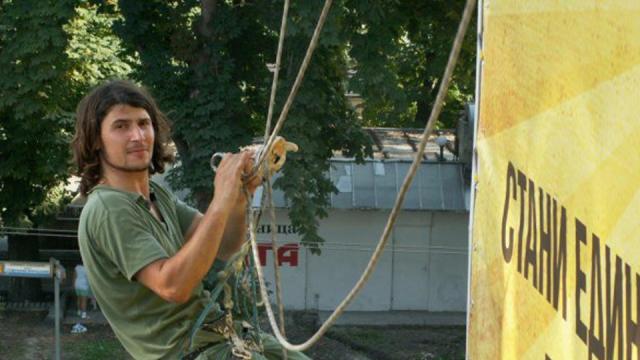
Plamen Goranov self-immolated last Wednesday.
So, Bulgarians are back in the 90’s, but they don’t feel younger. Just deceived. Some of them speak of revolution, but it’s rather a make-up exam after the nation failed in 1990 and 1997.
The first failure was easy to explain with trivial arguments, considered now as axioms: five centuries of Ottoman domination, lack of democratic tradition, missed spring of 1968 and close relations with the Soviet Union (whose most faithful ally was Sophia). Paradoxically, the former communists won Bulgaria's first democratic elections in 1990 despite the “wind of change.”
The second failure is more bitter and dramatic. In 1997, hyperinflation, insecurity and reluctance to privatize tore out the socialist-ex-communist government. After coordinated pressure from America and Russia, a right-wing party came to power. Bulgaria finally headed to the EU and NATO. The country got modern-looking institutions, politicians learned the Brussels slang and our social services were dressed up and privatized without debate.
Included in the so-called liberalization were the country's water supply and energy distribution - something that faced violent resistance in other EU countries, but for which every criticism or opposition in Bulgaria was cursed as communist nostalgia.
In fact, the cartel of enthusiastic "reformers" included all of the parties - socialist, liberal, popular and ethnic Turkish - that have acceded the government since 1997. All of them subscribed to the neoliberal dogmas and created a perverse, partocratic system living in lucrative symbiosis with the oligarchy: protected by mafia-style Omerta, respected by the mainstream media, owned by the same oligarchy, and eased by the acquiescence of everyday Bulgarians who chose to survive individually or to emigrate -- more than a million left the country -- rather than to stand for their rights in common action.
Until, that is, February of 2013 when electricity and heating bills exploded and detonated consumers' rage. The riots in the past week forced the government to resign. People are still in the streets, nobody has proposed a way out of the crisis and there is even no cabinet to be blamed.
The rupture is horizontal: between the disavowed political class and the people, who are devoid of money, justice and perspective. Protesters are trying to organize, presenting themselves as “citizens” because the word "politic" is considered a shaming iron brand.
The most dramatic act of protest was the self-immolation last Wednesday of Plamen Goranov, 36, in the coastal city of Varna, following a previous self-immolation by another Bulgarian man several weeks ago. Plamen gave an ultimatum to the Mayor of Varna, Kiril Yordanov, to resign. But Yordanov, well-known for his tight links to the powerful financial investment group TIM Holding, ignored Plamen, who kept his word.
The shock of Plamen's self-immolation echoed around the social networks but sank amid the general outcry. In a cynical world there is no room for martyrs. Disillusion prevails over sympathy. Plamen is still in hospital fighting for his life as his friends try to find blood that will ensure a successful transfusion.
Meanwhile, Bulgarians are in the streets. The transition is about to be restarted. This time, people hope it is to be done on a safe and moral basis. Now the question: is the rebel consumer ready to become an honest citizen?
Ivo Hristov is a journalist, writer and translator, and a founder of Solidarna Bulgaria.
3 WAYS TO SHOW YOUR SUPPORT



- Log in to post comments


