
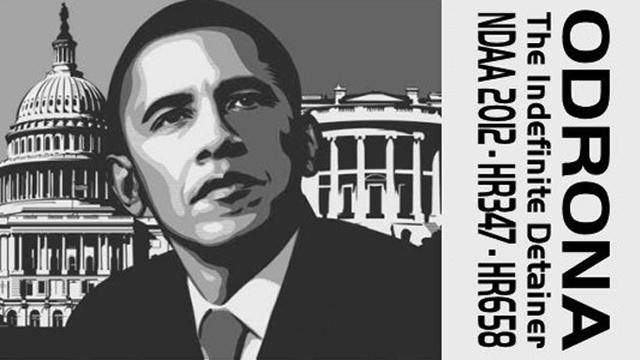
In January, I sued President Barack Obama over Section 1021(b)(2) of the National Defense Authorization Act (NDAA), which authorized the military to detain U.S. citizens indefinitely, strip them of due process and hold them in military facilities, including offshore penal colonies. Last week, round one in the battle to strike down the onerous provision, one that saw me joined by six other plaintiffs including Noam Chomsky and Daniel Ellsberg, ended in an unqualified victory for the public. U.S. District Judge Katherine Forrest, who accepted every one of our challenges to the law, made her temporary injunction of the section permanent. In short, she declared the law unconstitutional.
Almost immediately after Judge Forrest ruled, the Obama administration challenged the decision. Government prosecutors called the opinion “unprecedented” and said that “the government has compelling arguments that it should be reversed.” The government added that it was an “extraordinary injunction of worldwide scope.” Government lawyers asked late Friday for an immediate stay of Forrest’s ban on the use of the military in domestic policing and on the empowering of the government to strip U.S. citizens of due process. The request for a stay was an attempt by the government to get the judge, pending appeal to a higher court, to grant it the right to continue to use the law. Forrest swiftly rejected the stay, setting in motion a fast-paced appeal to the 2nd U.S. Circuit Court of Appeals and possibly, if her ruling is upheld there, to the Supreme Court of the United States. The Justice Department sent a letter to Forrest and the 2nd Circuit late Friday night informing them that at 9 a.m. Monday the Obama administration would ask the 2nd Circuit for an emergency stay that would lift Forrest’s injunction. This would allow Obama to continue to operate with indefinite detention authority until a formal appeal was heard. The government’s decision has triggered a constitutional showdown between the president and the judiciary.
“This may be the most significant constitutional standoff since the Pentagon Papers case,” said Carl Mayer, co-lead counsel for the plaintiffs.
“The administration of President Obama within the last 48 hours has decided to engage in an all-out campaign to block and overturn an order of a federal judge,” said co-lead counsel Bruce Afran. “As Judge Forrest noted in her opinion, nothing is more fundamental in American law than the possibility that journalists, activists and citizens could lose their liberty, potentially forever, and the Obama administration has now lined up squarely with the most conservative elements of the Republican Party to undermine Americans’ civil liberties.”
The request by the government to keep the law on the books during the appeal process raises a disturbing question. If the administration is this anxious to restore this section of the NDAA, is it because the Obama government has already used it? Or does it have plans to use the section in the immediate future?
“A Department of Homeland Security bulletin was issued Friday claiming that the riots [in the Middle East] are likely to come to the U.S. and saying that DHS is looking for the Islamic leaders of these likely riots,” Afran said. “It is my view that this is why the government wants to reopen the NDAA—so it has a tool to round up would-be Islamic protesters before they can launch any protest, violent or otherwise. Right now there are no legal tools to arrest would-be protesters. The NDAA would give the government such power. Since the request to vacate the injunction only comes about on the day of the riots, and following the DHS bulletin, it seems to me that the two are connected. The government wants to reopen the NDAA injunction so that they can use it to block protests.”
The decision to vigorously fight Forrest’s ruling is a further example of the Obama White House’s steady and relentless assault against civil liberties, an assault that is more severe than that carried out by George W. Bush. Obama has refused to restore habeas corpus. He supports the FISA Amendment Act, which retroactively makes legal what under our Constitution has traditionally been illegal—warrantless wire tapping, eavesdropping and monitoring directed against U.S. citizens. He has used the Espionage Act six times against whistle-blowers who have exposed government crimes, including war crimes, to the public. He interprets the 2001 Authorization to Use Military Force Act as giving him the authority to assassinate U.S. citizens, as he did the cleric Anwar al-Awlaki. And now he wants the right to use the armed forces to throw U.S. citizens into military prisons, where they will have no right to a trial and no defined length of detention.
Liberal apologists for Barack Obama should read Judge Forrest’s 112-page ruling. It is a chilling explication and denunciation of the massive erosion of the separation of powers. It courageously challenges the overreach of Congress and the executive branch in stripping Americans of some of our most cherished constitutional rights.
In the last 220 years there have been only about 135 judicial rulings that have struck down an act of Congress. Most of the cases involved abortion or pornography. Very few dealt with wartime powers and the separation of powers, or what Forrest in her opinion called “a question of defining an individual’s core liberties.”
Section 1021(b)(2) authorizes the military to detain any U.S. citizen who “substantially supported” al-Qaida, the Taliban or “associated forces” and then hold them in military compounds until “the end of hostilities.” The vagueness of the language, and the refusal to exempt journalists, means that those of us who as part of our reporting have direct contact with individuals or groups deemed to be part of a terrorist network can find ourselves seized and detained under the provision.
“The Government was unable to offer definitions for the phrases ‘substantially support’ or ‘directly support,’ ” the judge wrote. “In particular, when the Court asked for one example of what ‘substantially support’ means, the Government stated, ‘I’m not in a position to give one specific example.’ When asked about the phrase ‘directly support,’ the Government stated, ‘I have not thought through exactly and we have not come to a position on ‘direct support’ and what that means.’ In its pre-trial memoranda, the Government also did not provide any definitional examples for those terms.”
The judge’s ruling asked whether a news article deemed by authorities as favorable to the Taliban could be interpreted as having “substantially supported” the Taliban.
“How about a YouTube video?” she went on. “Where is the line between what the government would consider ‘journalistic reporting’ and ‘propaganda?’ Who will make such determinations? Will there be an office established to read articles, watch videos, and evaluate speeches in order to make judgments along a spectrum of where the support is ‘modest’ or ‘substantial?’"
Forrest concurred with the plaintiffs that the statute violated our free speech rights and due-process guarantees. She noted that “the Court repeatedly asked the Government whether those particular past activities could subject plaintiffs to indefinite detention; the Government refused to answer.” The judge went on to criticize the nebulous language of the law, chastising the government because it “did not provide particular definitions.” She wrote that “the statute’s vagueness falls far short of what due process requires.”
Although government lawyers argued during the trial that the law represented no change from prior legislation, they now assert that blocking it imperils the nation’s security. It is one of numerous contradictions in the government’s case, many of which were illuminated in Forrest’s opinion. The government, she wrote, “argues that no future administration could interpret § 1021(b)(2) or the AUMF differently because the two are so clearly the same. That frankly makes no sense, particularly in light of the Government’s inability at the March and August hearings to define certain terms in—or the scope of—§ 1021(b)(2).” The judge said that “Section 1021 appears to be a legislative attempt at an ex post facto ‘fix’: to provide the President (in 2012) with broader detention authority than was provided in the AUMF [Authorization to Use Military Force Act] in 2001 and to try and ratify past detentions which may have occurred under an overly-broad interpretation of the AUMF.”
The government, in effect, is attempting to push though a law similar to the legislation that permitted the government to intern 110,000 Japanese-Americans during World War II. This law, if it comes back into force, would facilitate the mass internment of Muslim Americans as well as those deemed to “support” groups or activities defined as terrorist by the state. Calling the 1944 ruling “an embarrassment,” Forrest referred to Korematsu v. United States, which upheld the government’s internment of Japanese-Americans.
The judge said in her opinion that the government “did not submit any evidence in support of its positions. It did not call a single witness, submit a single declaration, or offer a single document at any point during these proceedings.” She went on to write that she found “the testimony of each plaintiff credible.”
“At the March hearing, the Court asked whether Hedges’ activities could subject him to detention under § 1021; the Government stated that it was not prepared to address that question. When asked a similar question at the August hearing, five months later, the Government remained unwilling to state whether any of plaintiffs’ (including Hedges’s) protected First Amendment future activities could subject him or her to detention under § 1021. This Court finds that Hedges has a reasonable fear of detention pursuant to § 1021(b)(2).”
The government has now lost four times in a litigation that has gone on almost nine months. It lost the preliminary injunction in May. It lost a motion for reconsideration shortly thereafter. It lost the permanent injunction. It lost its request last week for a stay. We won’t stop fighting this, but it is deeply disturbing that the Obama administration, rather than protecting our civil liberties and democracy, insists on further eroding them by expanding the power of the military to seize U.S. citizens and control our streets.
3 WAYS TO SHOW YOUR SUPPORT



- Log in to post comments


