
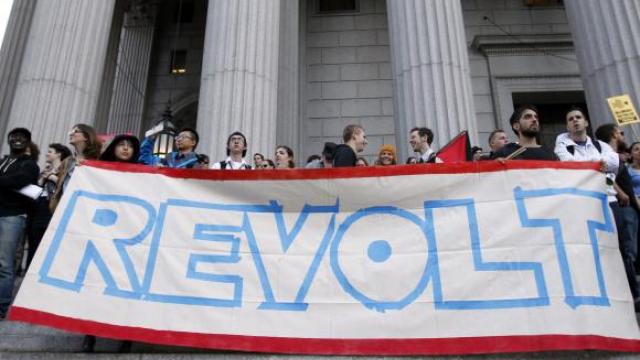
"Après moi, le deluge."
Little could King Louis XV have predicted that his unfortunate grandson, the enlightened and well-intentioned but indecisive Louis XVI, would succumb to a guillotine after two expensive wars, national bankruptcy, and a revolution. Why does the French Revolution still resonate today and what can we learn?
Then, as now in America, French society was quite literally divided between the 1% and 99%, with the clergy and nobility belonging to the 1% (or thereabouts) and everyone else - from beggars to bankers - to the 99%. Then, as now, wealth was concentrated disproportionately on top, as the nobility owned a whopping 33% of the land and sizable amounts of government stock. Not only did they exact seigneurial dues from their communities but they also paid no direct taxes. Even less well-off nobles did better than most, including the French Paris Hiltons of the day who had “no taste for reading...nor indeed any occupation, but that of dressing their hair and adorning their bodies,” as Scottish novelist Tobias Smollett commented. Plus ça change!
At the other end of the social spectrum, nearly 50% were underemployed or impoverished. Then, as now, those slightly better off felt the perpetual risk of sinking into destitution especially during a bad harvest. The fact that prices rose considerably faster than wages didn’t help either. As one inspector of manufactures observed in 1777, “Workmen today need twice as much money for their subsistence, yet they earn no more than fifty years ago when living was half as cheap.”
More striking still are the parallels between ideas for reform now and then, as recorded in the cahiers de doléances of spring 1789, an early government survey of public grievances. If laborers and shopkeepers demanded more stringent trade regulations, peasants exhorted nobles to control the dirty effluent flowing from their mines. Many resented being treated “like slaves.” In turn, the middling orders desired “careers open to talents,” encouragement of enterprise, and an end to noble privileges. As for the nobility, they predictably sought a reinforcement of privileges and tax exemptions: after all, because their great-great-great-etc. grandfather fought in the wars, only commoners, i.e., the “little people,” should pay taxes. And much like billionaire Mitt Romney supporter and hedge-funder Ken Griffin, they also believed that the 1% deserved even greater political influence. Altogether, 18th-century France was a world where “the distance which separates the rich from other citizens is growing daily. Hatred grows more bitter and the state is divided into two classes: the greedy and insensitive, and murmuring malcontents.”
And the times certainly were a-changin.’ Not unlike Dylan in the 1960s, French writers and critics of the 1760s were already prophesizing with their pens, vindicating the 99%. The notorious atheist Baron d’Holbach (a frenemy of Voltaire) presciently observed that “bad laws are those that have as their object the welfare, the preservation, and the security of only a few members, at the expense of the rest of society.” Anyway, weren’t “laborers” and “intellectuals” more useful to society than “opulent imbeciles?” Fellow radical Diderot broadly anticipated Marx and Engels, calling for “downtrodden people of the world” to “rise up against their oppressors!” Not least, a near-viral stream of anti-aristocratic, anti-monarchical and anti-clerical pamphlets in the 1770s and ‘80s would stoke popular hostility, leading the chancellor of the French judiciary to dread a “revolution in ideas.”
And erupt it did - particularly after Louis XVI failed to stave off national bankruptcy during a three-year battle over taxes on the 1%. For spectators around the world, the early stages of the revolution were nothing short of sublime - much like the Arab Spring and the worldwide Occupy Movement. Wordsworth cried, “Bliss was it in that dawn to be alive!” while George Washington declared it to be “of so wonderful a nature.”
Indeed, the collective cooperation and unity amazed many, beginning with the spirited popular support for the representatives of the Third Estate and the creation of a new National Assembly - not to mention the diverse crowd that protested Louis XVI’s unexpected dismissal of the well-liked minister Jacques Necker before storming the Bastille. Or the crowd of 7,000 women that forced their way into the National Assembly a few months later, demanding a resolution on bread prices and renewed support of the revolution. Even more impressive today are the laws passed between 1789 and 1793, before the onslaught of The Directory and Napoleon: slavery was abolished, homosexuality decriminalized (unlike in Britain) and property qualifications for suffrage eradicated. Severe penalties were to be introduced for wife-beating and procedures for spousal separation and divorce facilitated. Interestingly, however, women would not attain suffrage despite their considerable role in the revolution: perhaps because Robespierre had found himself too intimidated at a meeting of the Revolutionary Republican Citizenesses.
It is, of course, unfortunate that the revolution came to be tarred by excessive brutality. However, let’s not forget that the 18th-century world was a far more violent one than our own and that Louis XVI himself had only just abolished some of the most spectacular punishments in 1788: including drawing and quartering, breaking on the wheel and public burnings. Yet even then, mobs refrained from indiscriminate violence on their “betters,” choosing only to target the most egregious: for instance, the lord who imprisoned an 85-year-old woman for stealing a loaf of bread. Or Necker’s ministerial replacement, Foulon, for purportedly hoarding grains and quipping, “If the poor are hungry, they should eat straw.” (As a finishing touch, straw was stuffed into his mouth after a beating and execution.)
Less justifiable are the persecutions conducted by the Jacobin government even when violent threats from royalists and counterrevolutionaries are accounted for. Far from embracing a democratic ethos, Robespierre and his inner circle replicated an absolutist, hierarchical ancien-régime paradigm of authority: one all too evident from his rejection of Girondins and radical women. Ultimately, then, the tragedy of the revolution was not that it went too far--but not far enough.
But for all that, the French revolution continues to teach and inspire us, as it has for countless others. Certainly the French have learned, as they enjoy greater social mobility and job security than many others - including Americans. Perhaps we’ll learn to rethink entitlement in our day and age, whether in the form of rampant grade inflation at elite universities or bloated CEO compensation. Learn to shift tax burdens. Learn inclusiveness by listening to others and eschewing vertical, authoritarian paradigms for more egalitarian ones: in short, learn to embrace the principles of liberté, égalité, fraternité all the way. Vive L’Occupy Worldwide!
Frances A. Chiu earned her doctorate at Oxford University and is an assistant professor at The New School. She has a blog.
3 WAYS TO SHOW YOUR SUPPORT



- Log in to post comments


