
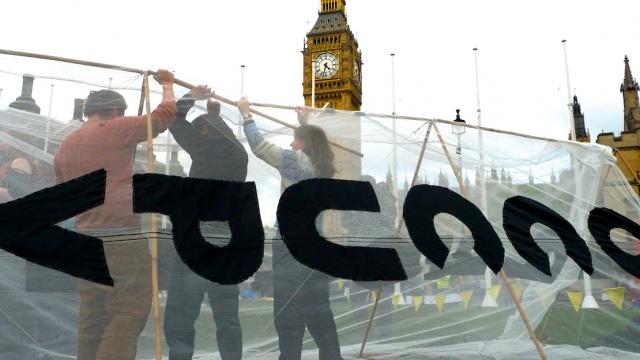
“Occupy Democracy asserts Britain does not have a functioning democracy, a message that threatens the establishment, which is why they came in so heavy-handed and surrounded Parliament Square with fences to stop our protests,” says Maria Saunders, a supporter of the Occupy Democracy movement in London.
“When they spoke about it in the House of Lords, Lord Bates, Undersecretary of the Home Office, stressed how the state needed to quickly quell the protest as the numbers were growing. The establishment clearly wants to stamp out dissent and not listen to the voices of the people of this country.”
Occupy Democracy began with a nine-day occupation of Parliament Square on Oct. 17, 2014. By Oct. 21, high-level fences were erected, pushing the occupation on to a small strip of grass nearby. Although the protest faced constant harassment – including mass arrest – by police, it continued to host skill-shares, workshops and general assemblies on different topics: from inequality and ecological destruction to corruption in British politics and the progressive alternatives.
The peaceful protest returned for a weekend in November with a program that included a talk by the former U.K. Ambassador to Uzbekistan, Craig Murray – a man the British establishment attempted to silence after he blew the whistle on U.K. complicity with Uzbekistan's human rights abuses.
Then, in December, Occupy Democracy turned its focus to Britain’s housing crisis and homelessness, partly in response to a report last year that found that the austerity-driven Coalition Government had contributed to a 34% increase in homelessness.
Saunders tells me that after the December occupation, a great deal of the energy went straight into Love HQ, a squatted ex-RBS Bank building where food was handed out to homeless people over Christmas. Despite being evicted by the police, Love HQ managed to continue feeding the homeless while moving to different locations around central London.
Since the protest's inception, the policing reaction to Occupy Democracy underlines the degree to which authorities appear to feel threatened by it. Writing in the Guardian, David Graeber described the mass arrests, and the aggressive and at times banal nature of the policing during the October occupation: “The police act as if the possibility of non-violent camping is an existential threat to the very idea of civil government."
But demonstrating in public about progressive alternatives isn't the only way Occupy Democracy is challenging the establishment. It has just initiated legal proceedings against authorities as well.
Acting as legal representation, the human rights advocacy group Liberty has written to the Greater London Authority (GLA) challenging the blocking off of Parliament Square as unlawful. Liberty argues that the GLA is ignoring its legal duties to facilitate and enable peaceful assembly and protest, rights protected by the European Human Rights convention.
The letter requires the GLA to reply by Jan. 19. If the GLA disagrees and states that the policing actions were lawful, Liberty says it will begin procedures to start a judicial review.
George Barda is an Occupy supporter and the claimant in the case. He says a judicial review is the only route for citizens to challenge whether authorities are acting legally.
Liberty’s letter is addressed to Boris Johnson, the mayor of London, who may have personally been involved in the decision to fence off the Square. Johnson already has a track record for attacking the Occupy movement. In October 2011, the first month of the U.K.-based movement, he called for new laws to counteract the Occupy camps he thought would “erupt like boils.”
Barda suggests the GLA’s tactics have greatly infringed on the Occupy Democracy camp in comparison to the response in 2011 and 2012 at St. Pauls Cathedral.
“By physically removing our right to protest on Parliament Square, the authorities have been able to harass us and portray the movement being in constant tensions with the police. This creates the opposite impression of the first Occupy camp, where you had an open and welcoming space,” he says.
On top of a legal challenge, Barda suggests the judicial review will bring further attention to the government’s crackdown on the right to protest, and highlight the ongoing challenge that Occupy Democracy is posing to a corrupted political and economic system.
Throughout the Coalition Government's reign, attacks on the right to protest have intensified. Further recent examples include 76 arrests at a peaceful die-in held in Westfields, one of Britain's largest shopping centers, in solidarity with the death of Eric Garner who was killed by police in New York last summer.
Another peaceful protest turned violent when police used C-S gas and assaulted students for occupying the lobby of their university in Warwick. And further evidence of state repression against peaceful protests was revealed last month in this Guardian expose, which showed how police were using pre-charge bail conditions as a way “to ban hundreds of innocent people from attending lawful demonstrations.”
Occupy Democracy supporter Joe Todd asserts these incidents “show an increased crackdown on people going into the streets to protest and organize as we approach the election. In effect, our society is not functioning.”
Nevertheless, Occupy Democracy vows to continue to challenge the establishment with its return to Parliament Square each month before May’s General Election. The next event, scheduled for Jan. 24, will connect with protests against Britain's continuing nuclear weapons program.
Saunders tells me that the issue of nuclear arms also represents a democratic crisis in the U.K. “Our government without any consultation from the people is spending £100 billion on weapons of mass destruction that we will never use, while it is cutting vital services like the NHS, which people need on a daily basis,” he says.
In February, Occupy Democracy says it will return to the square for Valentine’s weekend – this time with a message of love. And initial discussions are framing March as a month when the movement will link with massive climate marches and create a space building toward December’s crucial climate summit in Paris. Also in March, Occupy the Media plans to challenge Rupert Murdoch’s media empire over 10 days of action.
If the U.K. establishment has felt threatened by peaceful protests until now, it's got a lot more democracy to look forward to in the run-up to the May election.
3 WAYS TO SHOW YOUR SUPPORT



- Log in to post comments


