
Photo: GreenForAll.org.
Increasing Michigan’s renewable energy standard (RES) to 25 percent by 2025 would be a “job-creating machine” that doubles the number of green jobs in the state, according to a new Michigan State University (MSU) study. The 25 by 25 RES proposal, just certified by the state’s Bureau of Elections to appear on this year’s ballot, would more than double Michigan’s renewable electricity target from the current 10 percent by 2015 goal.
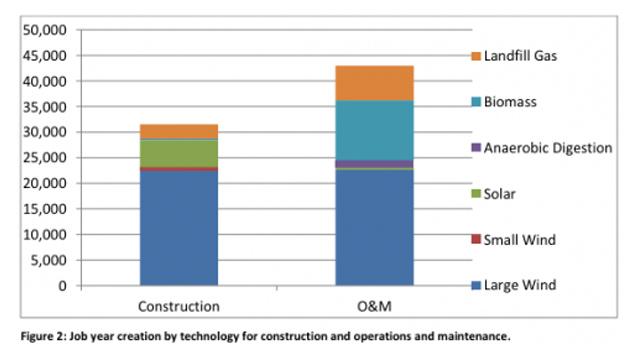
The MSU study, “Projected Job and Investment Impacts of Policy Requiring 25% Renewable Energy by 2025 in Michigan,” found that increasing the state RES would create at least 74,500 new green collar jobs, and potentially up to 113,850 jobs. Specifically, the RES would create 31,500 construction jobs, 43,000 operations and maintenance jobs, and around 4,200 manufacturing jobs.
Doubling Down, Long-Term
A Bureau of Labor Statistics analysis published in March found that Michigan currently has 80,000 green collar jobs, meaning the RES would at least double the state’s green workforce. In addition, the ballot measure would create more than $10 billion in new investments.
These new jobs would last, too. “Jobs” are defined as full job years in the study, meaning full employment for one person at 2,080 hours in a 12-month span. Operations and maintenance jobs are calculated to last for a 20 to 30 year duration.
These workforce and economic benefits directly contrast with a study published last month by a coalition opposing the RES, which found it would create $10 billion in higher utility bills. “All the evidence proves the simple fact that increasing Michigan’s renewable energy standard will put Michiganders back to work and bring much-needed new investments,” said Jim Moran, president of Advanced Energy Group.
Wind’s The Winner
The wind energy industry would be the biggest economic winner of all the renewable energy technologies modeled in the MSU study. A 25 percent RES would directly create 22,450 job years from construction, 14,500 potential job years from affiliated services like land leasing or legal services, 4,650 job years from increased lodging and food services for construction workers, and 1,130 job years to run and maintain the new wind farms for every year they are in operation.
Self Sufficiency, Please
But beyond doubling the green collar workforce, a 25 by 25 target make economic sense for Michigan’s electricity market. As Grist’s David Roberts recently noted, the state imports a majority of its fossil fuel resources at a cost of $22.6 billion, but has enough local renewable energy potential to power itself three times over.
Michigan’s Public Service Commission found the price of renewable electricity is now cheaper than coal-fired electricity generated in the state – and that’s not even considering external costs like asthma, greenhouse gases, or mercury pollution. In 2008, the state had 34 operational wind turbines. Today, it has at least 288, and likely more since energy companies are not required to report new turbines.
As Michigan voters tune into what’s at stake this November to determine their vote on the 25 by 25 ballot measure, they should remember that voting yes means economic and environmental benefits. “It’s a job-creating machine, with the added benefit of cleaner air, improved public health, and healthier communities,” said Chris Kolb, president of the Michigan Environmental Council.
Silvio Marcacci is Principal at Marcacci Communications.
3 WAYS TO SHOW YOUR SUPPORT



- Log in to post comments


