
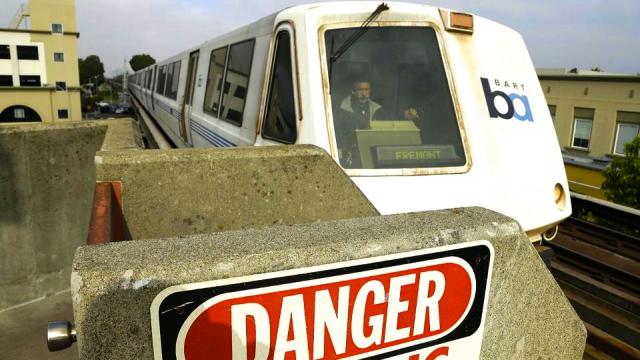
SAN FRANCISCO, California – It’s early morning on Tuesday and the Bay Area Rapid Transit (BART) trains move to and fro from the Montgomery station in the heart of San Francisco. Over the past few days, fears have manifested from local residents that BART workers would go on strike in their ongoing quest for increased wages and better healthcare.
While the two unions representing the workers called off a planned strike Friday night, and again Sunday evening, locals aren't mincing words amid frustration with the current standoff.
“I am in shock that a strike would even be considered at this time, with all the federal government problems and the struggles that we are all dealing with these days. I would be so angry if I had to look elsewhere to get to work,” said Natalie Ruiz, a 25-year-old marketing assistant in San Francisco's financial district.
She told Occupy.com that if the BART workers want to truly have the support of the people, “they need to do a better job of telling us why they are doing what they are doing.”
That seems to be the crux of the matter over the past few days, as fears loom of another BART strike that shuts down the vast Bay Area rail system. In July, workers went on a four-and-a-half day strike that left thousands of Bay Area residents angry and voicing their antagonism toward BART workers.
At the end of that strike, workers returned to work by choice, hoping to see an increase in support from the public for better working conditions and salary gains. But in the months since the end of the stoppage there has been little progress despite near constant discussions with transit management.
The agreement to extend the workers’ present contract through August 4 served more as a band-aid than a viable long-term solution. The conflict came to a head once again in October; two strikes have already been avoided, but negotiations have done little to ease the tension between workers and management.
Local newspapers are also joining the fray, albeit taking positions largely against any potential strike. In the past few days, like in August in the lead-up to the potential strike, mainstream publications are running article after article discussing the hardships residents faced during last summer's walk-out by BART workers.
“In my dream, all of the BART union workers got fired by management, every single BART manager was fired by the BART Board of Directors, and the BART directors were fired as well,” wrote one editorial contributor to the San Francisco Chronicle, highlighting the gulf that exists between workers, BART management and the public.
With negotiations continuing, there appears to be little public backing for the style of confrontation exhibited in the past five months by the two unions engaged in the fight – Amalgamated Transit Union and Service Employees International Union. Instead, residents are by and large angry and misinformed, including one Montgomery passenger who angrily asked the conductor recently, “Why the hell do you think you deserve a 50 percent raise?”
Before the conductor could respond, the passenger lumbered off. Looking slightly confused, the conductor told Occupy.com that “this [attitude] is becoming more common."
"People think we are demanding all sorts of crazy things and this is hard to understand," he said. "We should have done more to tell people exactly what is happening and why we are in need of something better.”
BART management presented a new offer to the unions that included a 10 percent pay raise over four years in exchange for employees contributing 1 percent of the base wage to their pensions the first year and 2, 3 and 4 percent in subsequent years.
That represents a pay increase from the 9 percent offered earlier, but a reduction in pension payments from 2 percent. Employees currently do not pay into their pension.
Unions, reported by local media, are asking for a 15 percent pay raise over 3 years in addition to a 6.5 percent raise the first year, and are offering to make pension contributions of 7 percent annually.
BART employees have not received a raise in over a decade, and the 15 percent raise asked by unions would be in line with inflation over that period in the Bay Area.
But now comes the hard part. With the federal government shutdown in its third week and a potential, cataclysmic debt ceiling wall looming Thursday, BART workers and residents well understand the challenges a strike could pose, which is why union negotiators, government officials and BART management are working around the clock to hammer out a new deal to ease the growing tension.
“We just want to have some justice in this process and [to] not hurt people who need to commute," said one BART union adviser, speaking on condition of anonymity, "and hopefully we can avoid a shutdown and get to a deal."

3 WAYS TO SHOW YOUR SUPPORT



- Log in to post comments


