Read

User menu

Search form

British Columbia Puts the Kibosh On Kinder Morgan Pipeline Expansion

British Columbia Puts the Kibosh On Kinder Morgan Pipeline Expansion
This article originally appeared on Reuters

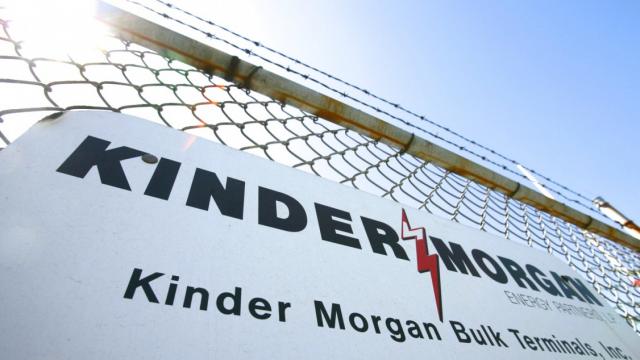
The British Columbia government said on Monday it will formally oppose the expansion of Kinder Morgan Inc's Trans Mountain pipeline to Canada's west coast, another blow to oil sands producers already reeling from a global crude price crash.

Kinder Morgan wants to nearly treble Trans Mountain's capacity to carry 890,000 barrels per day of crude from landlocked Alberta, to Burnaby, British Columbia, where it can be loaded on to tankers and shipped to lucrative Asian refining markets.

Alberta's carbon-intensive oil sands producers are desperate for improved access to international markets for their heavy crude, which is among the cheapest in the world and was priced at about $16.50 a barrel outright late Thursday afternoon.

But the C$5.4 billion ($3.79 billion) project has run into fierce environmental and aboriginal opposition.

British Columbia Environment Minister Mary Polak said Kinder Morgan had failed to provide the National Energy Board (NEB), a federal regulator, with an adequate plan to prevent or respond to an oil spill.

In 2012 the province's premier, Christy Clark, outlined five conditions that any company wanting to build pipelines in British Columbia would need to meet to win approval from her Liberal government. These included a "world-leading" marine and land oil spill prevention, response and recovery practices.

"We have not seen evidence that convinces us that those five conditions have been met," Polak told reporters.

The British Columbia government did not entirely rule out the possibility of Kinder Morgan meeting their requirements in future, adding that it will continue to evaluate the project.

"It does not close the door on them meeting that test in the future," Polak said.

Kinder Morgan is confident that it will be able to satisfy British Columbia's conditions by the time the regulatory process is complete, it said in a statement.

It could not meet all the requirements such as Aboriginal treaty rights alone and needed "multiple parties" to work together, the company said.

Kinder Morgan filed a final written argument for the Trans Mountain pipeline expansion project with Canadian regulators in December.

The opposition to Trans Mountain's expansion comes after U.S. President Barack Obama in November rejected TransCanada Corp's Keystone XL pipeline in a victory for environmentalists.

The same month, Canada's recently elected Liberal government said it will impose an oil tanker ban on British Columbia's northern coast, effectively slamming the door on Enbridge Inc's Northern Gateway pipeline.

Originally published by Reuters

3 WAYS TO SHOW YOUR SUPPORT

ONE-TIME DONATION

Just use the simple form below to make a single direct donation.

DONATE NOW

MONTHLY DONATION

Be a sustaining sponsor. Give a reacurring monthly donation at any level.

GET SOME MERCH!

Now you can wear your support too! From T-Shirts to tote bags.

SHOP TODAY

Sign Up

Article Tabs

From a pro-democratic perspective, civil society and new media organisations are surging in the aftermath of the Orban regime.

The country’s new prime minister, Andy Burnham, has promised a break from the politics of the last 40 years—realizing more broadly that Labour must stand up for the 99% against big business, or the party will become irrelevant.

The tragic shooting of Lorenzo Salgado Araujo is just the latest example of ICE having a fundamental disrespect for human life — further proving why the agency should be stripped of funding and shut down, and its rank-and-file agents and leadership prosecuted.

While the U.S., EU and their allies are enabling Rojava—the strongest force against Islamic State— to fall, it is vital for internationalists to continue to support this beacon of democracy and liberation.

June 23, 2026 may be remembered as the beginning of the end of the Democratic Party establishment.

The current wave of food recalls is a direct byproduct of President Donald Trump’s administration deliberately removing the safeguards put in place aimed at protecting American consumers more than a century ago.

From a pro-democratic perspective, civil society and new media organisations are surging in the aftermath of the Orban regime.

We can still celebrate success while simultaneously putting a cap on net worth.

The country’s new prime minister, Andy Burnham, has promised a break from the politics of the last 40 years—realizing more broadly that Labour must stand up for the 99% against big business, or the party will become irrelevant.

Much like the resistance to AI data centers, the opposition to Flock surveillance cameras has brought the left and the right together against billionaires who are trying to force America into becoming even more of a police state.

Much like the resistance to AI data centers, the opposition to Flock surveillance cameras has brought the left and the right together against billionaires who are trying to force America into becoming even more of a police state.

Posted 1 month 3 weeks ago

The country’s new prime minister, Andy Burnham, has promised a break from the politics of the last 40 years—realizing more broadly that Labour must stand up for the 99% against big business, or the party will become irrelevant.

Posted 1 month 3 weeks ago

We can still celebrate success while simultaneously putting a cap on net worth.

Posted 1 month 1 week ago

The current wave of food recalls is a direct byproduct of President Donald Trump’s administration deliberately removing the safeguards put in place aimed at protecting American consumers more than a century ago.

Posted 2 weeks 5 days ago

From a pro-democratic perspective, civil society and new media organisations are surging in the aftermath of the Orban regime.

Posted 3 weeks 16 hours ago

The current wave of food recalls is a direct byproduct of President Donald Trump’s administration deliberately removing the safeguards put in place aimed at protecting American consumers more than a century ago.

From a pro-democratic perspective, civil society and new media organisations are surging in the aftermath of the Orban regime.