
A colorful mass of banners decrying the effects of the government’s austerity measures slowly edged their way down the capital’s streets, as tens of thousands of protestors gathered one recent weekend ago in London. A dominant message being waved wildly in the air was that the austerity cuts encroached on schools and were causing an education crisis in Britain.
Following a three-year freeze imposed by the Coalition Government in April of 2011, most state schools in England have been forced to tighten their belts and make cuts. Despite the introduction of the Pupil Premium – additional funding for publicly funded schools in England, designed to raise the attainment of disadvantaged pupils – an analysis conducted by the Institute of Fiscal Studies (IFS) found that around 80 percent of secondary schools will have their real-time budgets cut in the forthcoming years. Around half of primary schools are likely to see real-terms decreases of more than five percent.
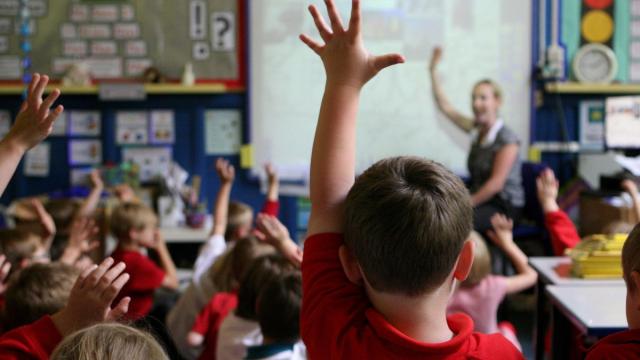
And the real-term budget cuts have already taken their toll. With more teachers being made redundant, class sizes swelling, head teachers wrestling with holes in their budgets, and numerous subjects being dropped from the curriculum, the picture in Britain’s modern-day classrooms is bleak.
Cameron’s promise to protect “flat cash” per pupil spending, which would reduce in value and inflation, was ripped apart by the opposition. The prime minister’s cry that “more could be achieved with less” was condemned by Labour’s Tristram Hunt, who told the BBC: “The truth is that you can’t protect schools when you have plans to take spending as a share of GDP back to levels not seen since the 1930s.”
Indeed, the situation facing U.K. schools today is a far cry from Cameron’s pre-election mandate to make “no cuts” to school funding. A recent analysis by the IFS shows, in fact, the opposite, as secondary schools in England face the steepest cuts to funding since the 1970s. The IFS forecasts by 2020 there will be a fall in spending of 7 percent per student across England. The analysis also highlights blatant dissimilarities in local authority funding.
The IFS's figures have initiated calls by teacher unions to rethink the funding freeze. Referring to the think tank’s analysis, Russell Hobby, General Secretary of the National Association of Head Teachers, told the Guardian, “This backs up what our members have been saying. With flat cash education spending at time of rising costs, school budgets are being pushed to breaking point.”
Running on Empty
The institute's findings followed a study made by the Association of School and College Leaders, in January, which surveyed almost 900 teachers and senior leaders, mainly from secondary schools. It found that during the previous 12 months, more than 38 percent of the respondents had made redundancies in their schools. An even greater number of redundancies had been made in teaching support roles.
Over half of the survey’s respondents said they believed that during the next year, their school’s financial situation would reach critical or extremely serious levels. More than 50 percent of the head teachers and managers who participated in the research said they would need to make more redundancies and over 75 percent said they expected class sizes to increase.
If the quality of teachers' and students' performance would not be affected, the cuts may not be as concerning. But as the survey revealed, 77 percent of participants said financial pressures had a “detrimental effect on education provision.” One head teacher from a school in West Sussex, in the south of England, faces a £341,000 ($494,000) budget deficit and is being forced to run classes made up of at least 30 pupils.
“We’re running on empty,” the head teacher told the Guardian.
And it’s not just the number of teachers and support staff that is dwindling in U.K. schools, forcing classroom sizes to swell, and focused teaching attention to diminish. Subjects are also being dropped as a result of the budget cuts. Economics, German, textiles, dance and food science are being dropped, a move that has angered many teachers and parents.
As the West Sussex head teacher said: “I am incandescent that I cannot offer German classes for those who would like it. I am furious that I am pushed far into a corner. I have almost no options left. It’s cutting into the heart, and that’s wrong.”
What has been the Tories’ solution to the burgeoning problems facing Britain’s schools? An expensive reorganization of the school system, which will force every school in the country, primary and secondary, to become an academy by 2020, ahead of the next General Election. According to the shadow education secretary, Lucy Powell, this "will remove even more money, time and effort away from where the focus in schools should be – on rising standards.”
Speaking to Occupy.com, Dr. Andy Pickard, former head of education at Manchester Metropolitan University, echoed concerns about the move to change all state schools into academies, stating:
“By 2010 it was clear that the academy model was a ‘busted flush.’ Commercial interests were simply not interested in making up any resource gap created by government reluctant to increase personal taxation. Rather the reverse: they saw education as a source of company profit. As a consequence, it is schools that have been required to deliver better standards on a reduced resource base and the evidence is that this particular road is reaching the end. Whether schools are academies or something else is secondary to ensuring that education is financially viable.”
One teacher from an academy school in Manchester, who wished to remain anonymous, told Occupy.com about the alarming level of cuts being made at their school – with teaching staff facing redundancy, pastoral support workers and special needs teachers not having their contracts renewed, and the number of teaching assistants likely to be more than halved by September.
“Schools are keen to save money where they can, even at the potential detriment of pupil wellbeing,” the teacher said. She spoke about the feeling of uncertainty among staff at the school, and the fact that morale is very low in the profession in general. The teacher also talked about an alarming case involving the misappropriation of current and past funding for vulnerable groups in the school. In this case, the Pupil Premium money aimed at providing disadvantaged pupils with more educational support was being withheld by the school’s academy trust.
With power being snatched from local authorities and placed in the hands of groups with "commercial interests," instead of teaching standards improving and achievement levels rising, the academy model looks set to become a breeding ground for financial mismanagement where profits rank above the interests of pupils.
3 WAYS TO SHOW YOUR SUPPORT



- Log in to post comments


Comments
Frederic Smith replied on
And they say that 'Occupy' is dead.
Clear evidence that this avarice is digging it's own grave. Short changing the children is haunting the corrupt body politic. The children can be much better educated by not attending a morbid and archaic 'educational' training system in the first place.
f.