
Not long ago we were told that with the introduction of the Internet and other technological innovations, the advanced economies of the West were entering a new age in which a highly skilled “Creative Class” would emerge. No longer would workers toil away in factories; instead they would be highly compensated for their intellectual and creative work.
With globalization and free trade agreements like NAFTA, the manufacturing jobs that led to the largest expansion of the middle class in recorded history were outsourced to countries that offered fewer protections for workers and much lower wages. The new “creative” jobs that were supposed to replace them, for the most part, never materialized although many students did go heavily into debt trying to ensure they wouldn’t be left behind.
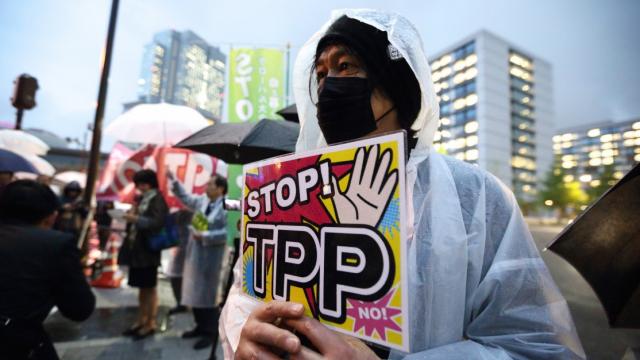
The Trans-Pacific Partnership is being negotiated behind closed doors and has been referred to as “NAFTA on steroids” by its many critics. It has galvanized civil society groups from Doctors Without Borders to the Electronic Frontier Foundation to campaign fiercely against it. Now, with so much opposition building to the TPP and President Obama’s plan to “Fast Track” it through Congress, it’s starting to look as if activists might be on the cusp of another victory in the battle against unchecked corporate power.
The main problem is that the TPP remains one of the few things that the president and many of his Republican congressional opponents seem to agree on.
But the truth is, we ourselves don’t know exactly what’s in the agreement because the negotiations have been shrouded in secrecy from the beginning. What we do know is that giving the president Fast Track Authority would mean that U.S. legislators would be unable to demand changes to the deal, would have limited time to debate or even read the text, and would be reduced to making a simple “Yay" or “Nay" vote before it becomes law.
To many observers, the TPP and other giant trade agreements, including one with Europe called the Transatlantic Trade and Investment Partnership, or TTIP, look increasingly like payback to the banks and corporations who were Obama’s true backers.
The TPP is being negotiated by 12 countries on the Pacific Ocean – including Australia, Canada, Chile, Japan, Malaysia, Mexico, New Zealand, the U.S. and Vietnam – who altogether make up 40% of global GDP. Critics of the plan were given a window into the negotiations when Wikileaks obtained and posted the section on Intellectual property (IP) in late 2013.
The provisions in this single chapter are far-reaching, touching on everything from access to medicine to the life of a copyright. And one crucial piece is what Big Pharma can expect to get out of the deal.
A Bonanza for Big Pharma
“The TPP is the most damaging trade agreement we have ever seen in terms of access to medicines for poor people," said Rohit Malpani of Doctors Without Borders.
Malpani is referring in part to “evergreening,” a series of practices whereby pharmaceutical companies try to retain the ownership of and royalties to drugs for which their patents have expired. This is done in a variety of ways, including making minor changes to inactive ingredients or finding a separate condition that a medicine can be used to treat. Using these techniques, the drug can then be re-patented, giving the company that owns it exclusive rights to profit from it for another decade or more depending on the jurisdiction.
A fear expressed by many critics of the TPP is that the plan would codify these practices into trade laws upheld by all the countries signing on, extending patents on already existing drugs that could otherwise be produced and sold more cheaply as generics – potentially affecting the healthcare of millions as a result. This especially worries both Australia and New Zealand, countries that use taxpayer money for subsidized drug plans in an attempt to grant equal access to medicine to all citizens.
The text released by Wikileaks includes a clause for compulsory licensing, which allows for the copying of patented medicines in a time of crisis. However, a recent study found that Vietnam would see an increase in the number of deaths among those with HIV due to a reduction in access to cheap antiretroviral drugs. One wonders if this constitutes enough of a crisis for compulsory licensing to come into effect.
Lobbyists for Big Pharma have been involved in the TPP negotiations from the beginning, while civil society groups, citizens and even members of the medical community haven’t gotten a seat at the table. In a letter recently published in the British medical journal The Lancet, 27 leaders in the global medical community wrote that “although USA-based industry advisors have been granted privileged access to negotiating documents, health agencies have been forced to rely on leaks for information” about the deal.
All of which points to the larger problem with the TPP: that it's being negotiated in secret because the vast majority of people in all 12 participant countries would reject it out of hand if they knew what it contained. The same leaked Intellectual Property portion of the agreement also contained provisions regarding Internet control and copyright law that Americans rejected in earlier domestic bills like SOPA and PIPA.
The handout planned for Big Pharma is just one of the corporate giveaways embedded in the TPP, and there are many, many more. From the little that has been revealed about the trade pact, it's clearly a bad deal for the rest of us – which is why so many are people are now mobilizing to stop it. To learn more about how you can oppose the Trans-Pacific Partnership, go here.

3 WAYS TO SHOW YOUR SUPPORT

- Log in to post comments


