
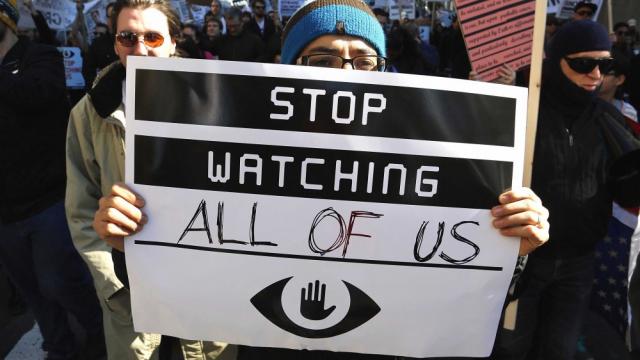
Last week, the Investigatory Powers Bill – or “Snoopers Charter” – was enshrined in U.K. law. The bill will build on existing legislation to force internet and mobile phone companies to keep a record of all citizens’ internet browsing and mobile phone use – even if they are not suspected of terrorist activity. The information will then be available to all British police and security agencies.
An official government statement insists that the bill is designed to “ensure that law enforcement and the security and intelligence agencies have the powers they need in a digital age to disrupt terrorist attacks, subject to strict safeguards and world-leading oversight.” Edward Snowden, on the other hand, described the legislation as “the most intrusive and least accountable surveillance regime in the West.”
Pam Cowburn, Communications Director at the Open Rights Group, a U.K.-based organization working to protect digital privacy rights, told Occupy.com, “This law will give the U.K. one of the most extreme surveillance laws ever seen in a democracy, with the police and 48 government departments – including the Food Standards Agency and Her Majesty’s Revenue and Customs – [able] to access web and mobile data. Authoritarian regimes with poor human rights records will look to this law to justify their own intrusive surveillance regimes.”
Cowburn believes the bill was deliberately rushed through after the U.K.’s controversial vote to leave Europe. “It’s been debated and passed while our media, MPs and public have been pre-occupied by Brexit,” she added. However, Cowburn anticipates that “we may see tech companies move their servers or entire businesses out of the U.K. if they are concerned about the impact of the bill on their business and customers.”
The public, too, has expressed outrage. An official petition to Parliament calling for the repeal of the law has gained more than 157,000 signatures. “This means the government will have to consider debating it again,” explained Cowburn, and “while this is unlikely to happen, it shows that there is a strength of feeling against the bill.”
Helen Fenwick, a professor of law at Durham University who specializes in media law, civil liberties and human rights, believes the passage of the bill was inevitable, given the direction surveillance policy was heading.
“I’m not surprised it came into law because it appears that certain of the powers were already being exercised under other legislation, but at times without a clear statutory basis. One such basis was also about to expire,” Fenwick told Occupy.com. “It reflects recommendations from the Intelligence and Security Committee and also, to an extent, those from the Independent Reviewer of Terrorism Legislation, David Anderson, who have both recently issued special reports on the legal framework for data retention and investigatory powers. Their recommendations were that the current legal framework for surveillance and communications data collation by public authorities and private companies should be replaced by a new comprehensive Act of Parliament.”
Fenwick said she thinks it's possible that companies might be able to relocate in order to avoid doing business under the bill. “But court compliance may be sought,” she added. Indeed, Apple has already addressed the matter in a statement the company issued to the Joint Committee on Human Rights.
“They wanted certain areas of the bill changed on the basis that it could give the government the power to demand Apple alters the way its messaging service, iMessage, works,” Fenwick continued. “The company said this would weaken encryption and enable the security services to eavesdrop on iMessage for the first time.”
And if a clandestine attempt at encryption is made by any individual or organization after the bill is implemented, what then? “Metadata could still be obtained,” she insisted. “If it is encrypted, then police or security services will seek to break the encryption.”
After the so-called Snoopers Charter gained royal assent last week, Rachel Logan, Amnesty UK’s Legal Program Director, said: “The U.K. government has managed to sneak these incredibly sweeping surveillance powers onto the books with very little fanfare. It’s not only the U.K. government asking you to ‘trust us,’ it’s also any government they decide to share it with, like the USA. It’s hardly surprising there seems to be a late-in-the-day panic about what that could mean given that recent political events have shown how quickly power can shift, and with it public trust in government use of our data.”
A case against the Investigatory Powers Bill will now be taken to the E.U. Court of Justice, with a verdict due later this month. For Cowburn, it signals some hope. “The courts may succeed where Parliament has failed in limiting surveillance,” she said.

3 WAYS TO SHOW YOUR SUPPORT



- Log in to post comments


