
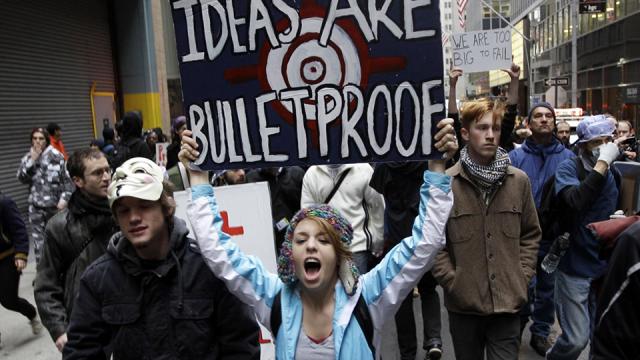
This week marks two years since I joined a ragtag crew of outraged young Americans in the streets of lower Manhattan.
We had exhausted the list of available political remedies as we watched our stalemated Congress spiral into deeper indecision. We refused to be silent in the face of a teetering economy and captured political system. We occupied Wall Street, and were soon joined in solidarity by thousands across the country and around the world.
We are the 99%!
That became the clarion call of a new generation of students and workers, young and old. We stood firm and we opened our arms to all who would dare enter into a new opening of political possibilities. Together, we rose up to confront immense corporate power.
Then, we fell.
Our fall was excruciatingly painful, co-ordinated by city mayors, police departments and counterterrorism forces across the country. They broke laws meant to protect basic civil liberties and political expression. The entire apparatus of the surveillance state, as revealed by whistleblowers like Julian Assange and Edward Snowden, was employed against its own citizens by a fearful government.
Moreover, the poor and homeless, whether protesters or not, were further criminalized as a result of our eviction. Thousands were arrested and charged with minor offenses that were later discarded. Hundreds more wait for their day in court in myriad lawsuits.
Justice was not served to Occupy Wall Street. It was rammed down our throats. The state's startling show of force played out in real time through livestream channels on the monitors of concerned parents and friends. A defiant Captain Ray Lewis, retired head of the Philadelphia police department, took an arrest while exhorting officers not to be mercenaries for Wall Street. The world watched in horror as three young women were enclosed in police nets and then pepper-sprayed.
Across the country, similar scenes of police violence – far from unusual in low-income neighborhoods but suddenly mainstreamed – transformed the national psyche.
The crackdown on Occupy began a diaspora that continues to this day: protesters returned to their community deeply affected by the experience. Those who once shared food in the OWS kitchen now feed the hungry of the 99% in their hometowns. When Hurricane Sandy hit New York City in October 2012, Occupy Sandy organized 70,000 volunteers to provide critical aid to survivors, leading the New York Times to note that Occupy is "capable of summoning an army with the posting of a tweet".
A new generation of game-changers has found its calling, and isn't waiting for the political establishment to give them the go-ahead to take initiative.
In our short lifetime, we've already changed the national conversation from debt and budget cuts to income inequality and corruption. And it's had a real effect. Richmond California Mayor Gayle McLaughlin, who marched with Occupy, now leads an initiative to force intransigent banks to negotiate with underwater homeowners through eminent domain.
Recently-elected Senator Elizabeth Warren, who supports Occupy and once proclaimed "the people on Wall Street broke this country", now sits on the powerful Senate banking committee.
In New York City, birthplace of the movement, elected officials and candidates who support Occupy values are surging in the polls, like Democratic mayoral frontrunner Bill de Blasio. (De Blasio recently stated in an interview that he wouldn't have shut down Occupy Wall Street.)
But changing the conversation is just part of the story. When politicians fail to protect the needy from predatory lending, we buy up distressed debt and cancel it. When banks threaten "underwater" homeowners with eviction, we occupy their homes, ratcheting up pressure on the banks to renegotiate. When local agricultural jobs are threatened by agribusiness behemoths that inject GMOs into our crops, we join with innovative groups like the Coalition of Immokalee Farmworkers, occupying farms and demanding fair pay and safe food.
And we're not just protesting. We're also building new economic models. The Occupy Money Co-operative is just one example. Formed by Occupy's Alternative Banking Group, it will provide low-cost financial services that return profits to communities rather than Wall Street, thereby shifting the balance of power from bankers to depositors.
Will Occupy return to stake out a new protest campground this year? I don't know. In any struggle, tactics shift as we learn from experience and experiment with new ways of growing grassroots power. Ours is still a project in its infancy, forever evolving, building upon the successes of the civil rights and antiwar movements, the anti-globalization and women's rights struggles, among many other calls for social and economic justice.
Sure, we face an uncertain future, but we embrace the chaos that defines our time. Because there is no alternative but to challenge the status quo of ever-increasing debt, shrinking job opportunities and disappearing civil rights.
Two years ago, in scores of encampments across America, a new generation found its calling. We will continue to move forward peacefully and deliberately in order to take back our county, our future and our dreams.
3 WAYS TO SHOW YOUR SUPPORT



- Log in to post comments


