
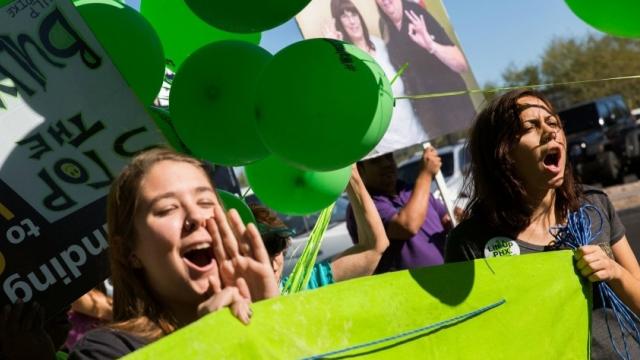
At least 19 U.S. states have introduced bills that attack the right to protest since Donald Trump's election as president, an "alarming and undemocratic" trend, U.N. human rights investigators said this week.
Maina Kiai and David Kaye, independent U.N. experts on freedom of peaceful assembly and expression respectively, are calling on lawmakers in the United States to stop the “alarming” trend of “undemocratic” anti-protest bills designed to criminalize or impede the rights to freedom of peaceful assembly and expression.
"The trend also threatens to jeopardize one of the United States’ constitutional pillars: free speech," they said in a statement, calling for action to reverse such legislation.
“From the Black Lives Matter movement, to the environmental and Native American movements in opposition to the Dakota Access oil pipeline, and the Women’s Marches, individuals and organizations across society have mobilized in peaceful protests, as it is their right under international human rights law and U.S. law,” Kiai and Kaye said.
-
The Arizona State Senate in February voted to expand racketeering laws to allow police to arrest anyone involved in a protest and seize their assets, treating demonstrators like organized criminals.
-
Portland, Oregon activists organizing against police killings of Black men, white nationalist politicians, and the countless systems of racism throughout our local, state, and federal governments are now considered “domestic terrorists” by Department of Homeland Security.
-
In January, North Dakota Republicans proposed legislation to legalize running over protesters if they are blocking roadways. (The legislation failed, for now.)
-
Missouri lawmakers want to make it illegal to wear a robe, mask or disguise (remarkably, a hoodie would count) to a protest.
-
In Minnesota, following the police shooting death of Philando Castile, protests caused part of a highway to shut down. Then, at the beginning of the state legislative session, Minnesota legislators drafted bills that would punish highway protestors with heavy fines and prison time and would make protesters liable for the policing costs of an entire protest if they individually were convicted of unlawful assembly or public nuisance.
-
Republicans in Washington state have proposed a plan to reclassify as a felony civil disobedience protests that are deemed “economic terrorism.”
-
Lawmakers in North Carolina want to make it a crime to heckle lawmakers.
-
In Indiana, conservatives want to allow police to use “any means necessary” to remove activists from a roadway.
-
Colorado lawmakers are considering a big increase in penalties for environmental protesters. Activists who tamper with oil or gas equipment could be, under the measure, face felony charges and be punished with up to 18 months behind bars and a fine of up to $100,000.
-
A bill before the Virginia state legislature would dramatically increase punishment for people who “unlawfully” assemble after “having been lawfully warned to disperse.” Those who do so could face a year in jail and a $2,500 fine.
The experts took particular issue with the characterization in some bills of protests being “unlawful” or “violent”.
“There can be no such thing in law as a violent protest,” the experts said. “There are violent protesters, who should be dealt with individually and appropriately by law enforcement. One person’s decision to resort to violence does not strip other protesters of their right to freedom of peaceful assembly. This right is not a collective right; it is held by each of us individually,” the experts stressed.
“Peaceful assembly,” they added, “is a fundamental right, not a privilege, and the government has no business imposing a general requirement that people get permission before exercising that right.”
The experts also emphasized that legislators should be mindful of the important role that the right to freedom of peaceful assembly has played in the history of American democracy and the fight for civil rights.
“We call on the U.S. authorities, at the federal and state level, to refrain from enacting legislation that would impinge on the exercise of the rights to freedom of peaceful assembly, expression and opinion,” they concluded.
3 WAYS TO SHOW YOUR SUPPORT



- Log in to post comments


