
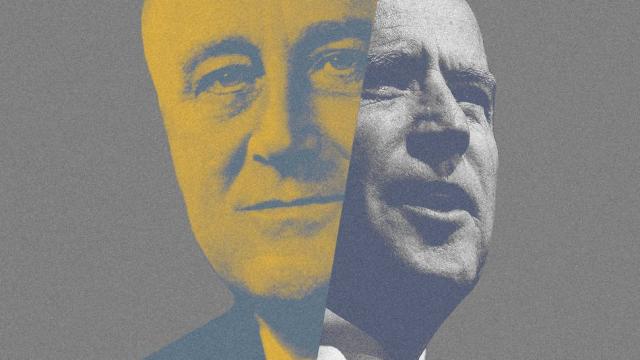
According to his first 100 days joint address to Congress, it’s fair to say President Joe Biden is recognizing the severity of the current moment. This new, more progressive Joe Biden declared an end to trickle-down economics, uttered the phrase “white supremacy is terrorism” from the Speaker’s dais, and proposed sweeping new programs that would invest trillions of dollars in revitalizing American infrastructure. It’s no secret that Biden is trying to cast himself as the 21st century version of Franklin Delano Roosevelt. But for all of his talk of massive public programs, Biden is still constraining himself with outdated economic thinking.
President Biden promised he would “pay for” his new jobs programs “without increasing the deficit” by increasing taxes on corporations and the wealthy. While taxing the rich is certainly a good way to reduce economic inequality and curb the influence the wealthy have on democracy, it’s not necessary to fund government spending. In her bestselling book The Deficit Myth, former Senate Budget Committee chief economist Stephanie Kelton – one of the foremost proponents of the Modern Monetary Theory (MMT) school of economics – pointed out that today, federal taxes don’t actually fund federal spending, and that government deficits are actually a sign of a healthy economy.
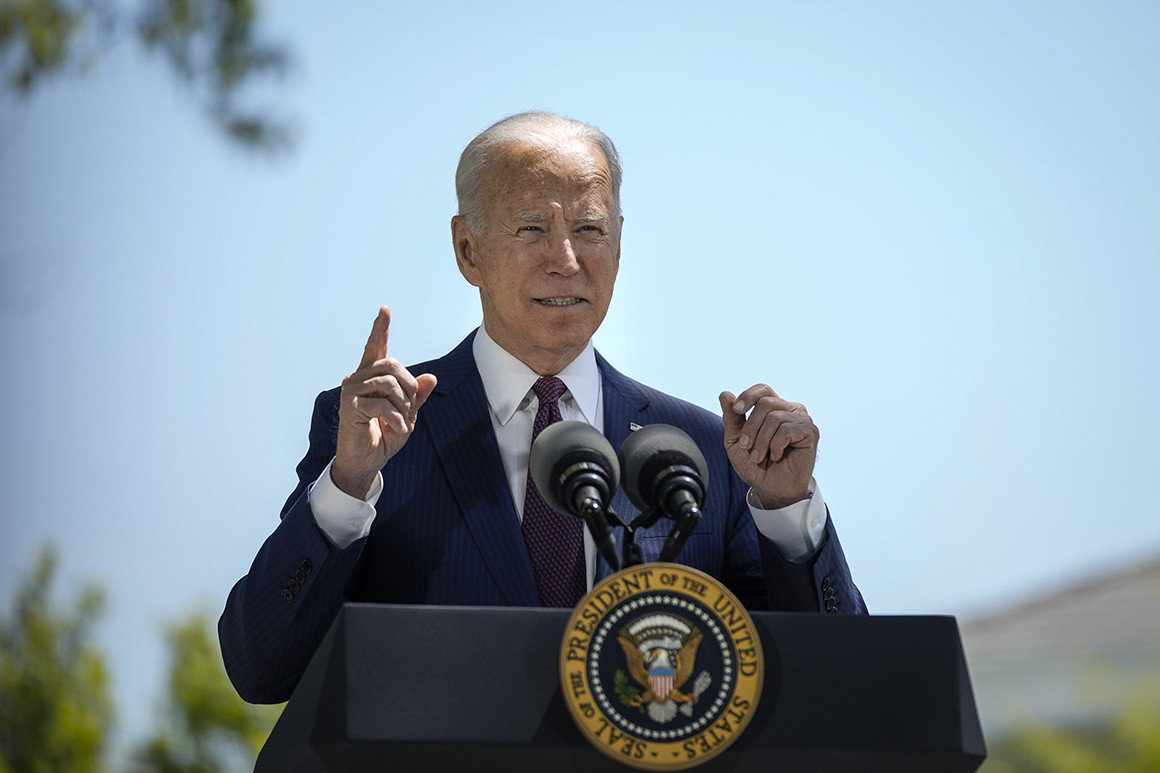
“There’s only one way to fund anything. Congress authorizes the funding, and the Fed changes the numbers in the bank account,” Kelton said in a phone interview.
In 1971, President Richard Nixon blew up the Bretton Woods Agreement – in which foreign governments could exchange US dollars for gold – and established the US dollar as a fiat currency. In layman’s terms, this meant the US government could increase the money supply without having to worry about also increasing the supply of gold. While Nixon’s presidency is rightfully remembered as one rife with corruption and hubris, his monetary policy proved historic – and could actually be what gets us out of the Covid recession.
In her book, Kelton describes the US as one of the few countries that has “monetary sovereignty.” Article I, Section 8 of the Constitution states that Congress has the sole authority “to coin money,” meaning nobody can issue US currency other than the US government. In a nutshell, this means it’s actually healthy for a currency issuer like the US to run deficits – especially since Federal Reserve Chair Jerome Powell said last year that “there’s no limit” to how much stimulus Congress should pursue, and that interest rates would remain near frozen until at least 2023.
“Trade deficits work like a vacuum. The trade deficit means the rest of the world is selling us more than they’re buying from us and as a consequence, dollars go out of the US economy. A government deficit does exactly the opposite. It works like a blower,” Kelton explained. “When the government puts $100 into the economy and only taxes $90 back out, government deficits make a financial contribution to our economy. A trade deficit sucks dollars out, a government deficit blows them onto balance sheets – it adds them.”
“A government deficit should never be something we try to eliminate,” she continued. “It’s just a matter of calibrating the flows, so the private sector, when it’s prepared to take the lead and consumers are optimistic and consumer sentiment is strong and wages are growing and households are spending a lot of money, that will crank the wheel of the economy and it will lead to economic growth and job creation because businesses will be swamped with customers. And when they’re swamped with customers, they respond by hiring and investing more. They’ll build more factories. They’ll buy more capital equipment.”
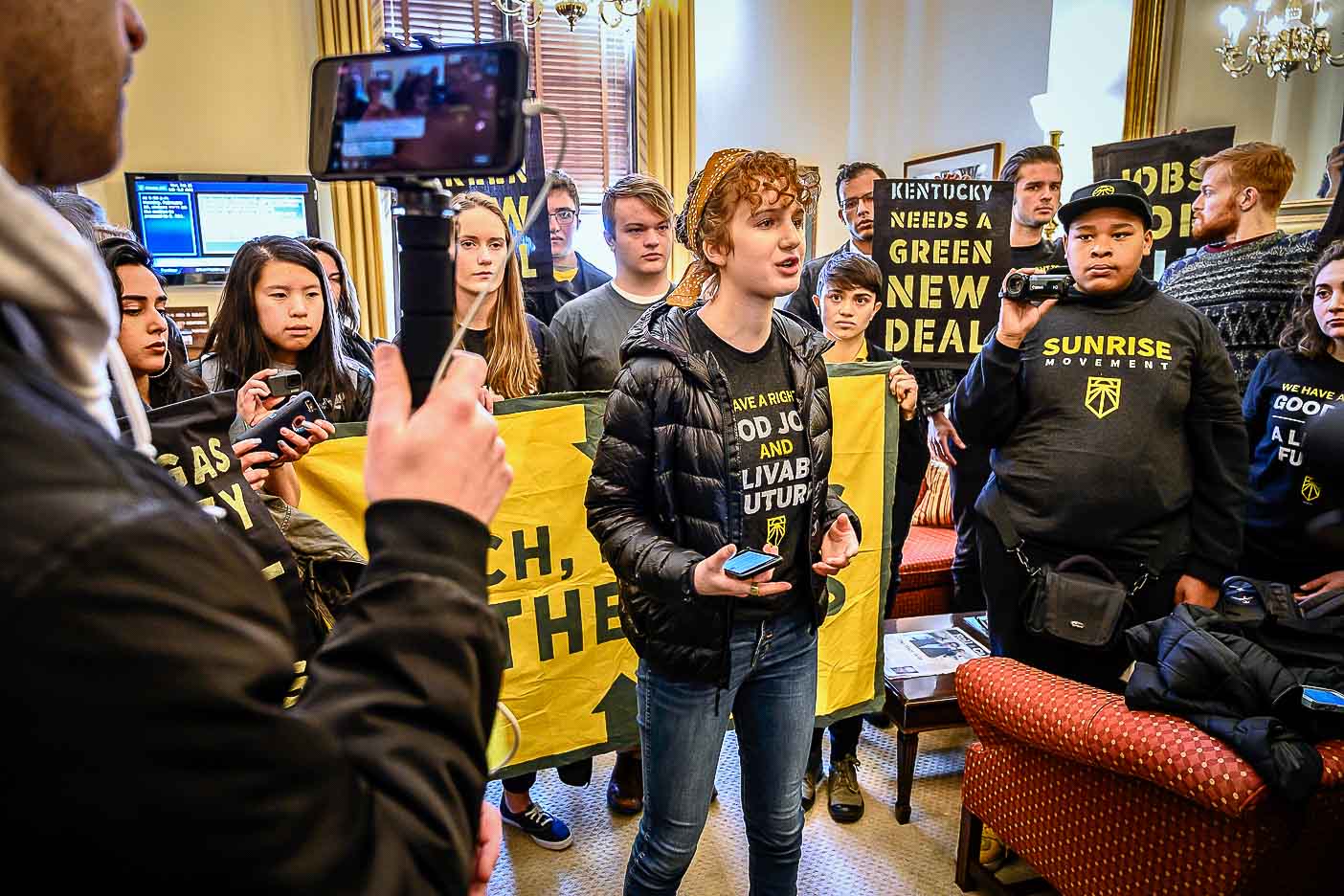
Supporters of the Green New Deal – which the youth-led Sunrise Movement describes as a massive new jobs plan that would “mobilize every aspect of American society to 100 percent clean and renewable energy” – argue that Biden’s proposed $4 trillion infrastructure package is not ambitious enough. A United Nations climate panel warned in 2018 that unless global carbon emissions were cut by 45 percent by 2030, the global temperature would increase by 1.5 degrees Celsius, causing irreparable damage to the biodiversity that maintains food chains and ecosystems. Congresswoman Alexandria Ocasio-Cortez (D-New York) has called on Biden to put forth a plan that would spend at least $10 trillion over ten years.
“Millions of people in the United States are unemployed,” Rep. Ocasio-Cortez said last month. “We have a truly crippled healthcare system and a planetary crisis on our hands, and we’re the wealthiest nation in the history of the world. So we can do $10 trillion.”
The prospect of injecting trillions of new dollars has conservatives worried about hyperinflation. Should Congress rely solely on printing money, they argue, it could make the value of the dollar worthless, raise the price of consumer goods, and force the Fed to raise interest rates. But Kelton is skeptical about inflation becoming a problem down the road.
“If we did something really wild and juiced aggregate demand to the point that we got a full employment economy before 2023, and the economy was so strong that the Fed was in a position to hike [interest rates], then yes, it would impact interest-sensitive sectors like housing and automobiles,” Kelton said. “But that’s a pretty hard point to get to.”
In a New York Times essay, Kelton proposed several policies to curb inflation should the economy begin to overheat. This includes relaxing limits on immgration to allow for more workers to take open jobs that otherwise wouldn’t be filled, repealing trade tariffs to make it easier for businesses to import raw materials from overseas and to incentivize consumers to buy imported goods, and passing new taxes to discourage corporations from outsourcing labor overseas, among others. Ultimately, Kelton believes there can be a symbiotic relationship between the public and private sectors, which would ultimately be driven by the deficit.
“The private sector can drive expansion until it can’t. At some point, something will happen. That’s why we have business cycles. If there’s a decline in spending, we get a contraction,” Kelton told me. “It’s not that the government’s deficit ever disappeared. It just got too small.”
“Capitalism runs on sales. That’s the bottom line,” she added. “And when sales falter, goods don’t get sold and businesses lay off workers. Because you don’t need workers if the demand is not there.”
Should Biden wish to be remembered as the next iteration of FDR, he’ll need to do more than simply build new roads and bridges – he’ll have to reject old ways of thinking about spending, embrace Modern Monetary Theory, and put forth a plan that’s just as, if not more ambitious than, the original New Deal. We may only get one shot at this – we owe it to future generations to get it right this time.
Carl Gibson is a freelance journalist whose work has been published in CNN, The Guardian, The Washington Post, The Houston Chronicle, Barron’s, Business Insider, The Independent and NPR, among others. Follow him on Twitter @crgibs.