Read

User menu

Search form

Five Years and Counting, Big Money Still Stalls Key Dodd-Frank Anti-Corruption Rule

Five Years and Counting, Big Money Still Stalls Key Dodd-Frank Anti-Corruption Rule
Mon, 7/20/2015 - by Jon Schwarz
This article originally appeared on The Intercept

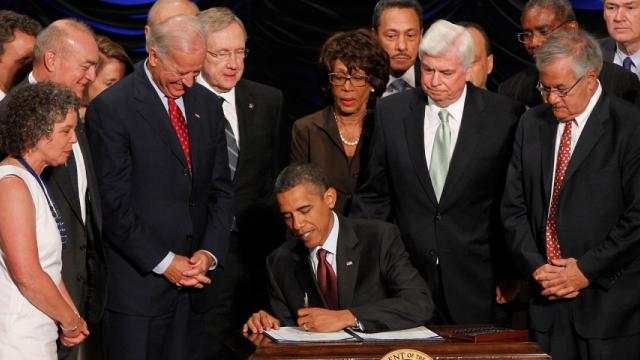
When Barack Obama signed the Dodd-Frank financial reform bill five years ago, on July 21, 2010, he looked extremely pleased with himself. It had been a tough fight, he said: “We had to overcome the furious lobbying of an array of powerful interest groups and a partisan minority determined to block change.” But now, Obama proclaimed, the bill’s reforms “will become the law of the land.”

Ha Ha PSYCH.

The reality of U.S. politics is that good ideas don’t win and take effect just because they’ve “become the law.” Yes, to get even that far, they have to have somehow threaded their way through a campaign system ruled by money instead of people; passed a House of Representatives overflowing with members from bizarrely gerrymandered districts; and made it past a filibuster in the anti-democratic Senate. But that is often just the start of the truly bloody trench warfare.

One case study is Dodd-Frank’s Section 1504. Congress, on July 21, 2010, gave the Securities and Exchange Commission 270 days to issue a rule on how exactly to implement it. Today, 1,821 days later, there still is no rule.

Section 1504 is intended to address a terrible problem, one so common it has two names: “the paradox of plenty” and “the resource curse.” Countries with lots of oil, gas and mineral wealth are, oddly enough, very frequently poor, corrupt and polluted.

What happens is that big multinational corporations have enormous incentives to bribe government officials so they can get the right to extract and sell the country’s natural resources. That, in turn, leads those government officials to spirit away vast sums of money that rightfully belong to the people to London or Zurich.

Not only do ordinary citizens miss out on the looting, but they tend to suffer from the ancillary corruption, wasteful spending, military adventurism and instability.

Section 1504 requires corporations traded on U.S. stock exchanges to publicly disclose the payments they make to governments for natural resources on all of their projects around the world.

People in, say, Angola would learn exactly how much money their government has received from big oil companies, making it harder for their leaders to hide and pocket as much of it.

Meanwhile, knowing what kind of a deal Angola struck, other governments could use that information to drive harder bargains.

The SEC did finally issue a rule for Section 1504 in August 2012, after a lawsuit by Oxfam America. But then the American Petroleum Institute, the main trade group for the oil industry, challenged the rules, and they were vacated by a U.S. District Court. Now the SEC claims it will issue a “proposed rule” — only the first step in the process — in April 2016.

Meanwhile, during the past five years, the API and Section 1504’s other major natural enemies, the U.S. Chamber of Commerce and the National Foreign Trade Council, have collectively spent $896 million lobbying (not just on this one section of Dodd-Frank, of course).

Oxfam America estimates that if developing countries had reasonable deals with oil multinationals, they should have received about $1.5 trillion for oil pumped during the five years of Section 1504’s non-enforcement.

But did they get reasonable deals? And of that potential $1.5 trillion, how much actually went to the countries’ real needs, and how much was spent by the president’s son on Michael Jackson’s glove? Thanks to the endless veto points in our system, where good ideas have to win every time and money only has to win once, we just don’t know.

Originally published by The Intercept

3 WAYS TO SHOW YOUR SUPPORT

ONE-TIME DONATION

Just use the simple form below to make a single direct donation.

DONATE NOW

MONTHLY DONATION

Be a sustaining sponsor. Give a reacurring monthly donation at any level.

GET SOME MERCH!

Now you can wear your support too! From T-Shirts to tote bags.

SHOP TODAY

Sign Up

Article Tabs

From a pro-democratic perspective, civil society and new media organisations are surging in the aftermath of the Orban regime.

The country’s new prime minister, Andy Burnham, has promised a break from the politics of the last 40 years—realizing more broadly that Labour must stand up for the 99% against big business, or the party will become irrelevant.

The tragic shooting of Lorenzo Salgado Araujo is just the latest example of ICE having a fundamental disrespect for human life — further proving why the agency should be stripped of funding and shut down, and its rank-and-file agents and leadership prosecuted.

While the U.S., EU and their allies are enabling Rojava—the strongest force against Islamic State— to fall, it is vital for internationalists to continue to support this beacon of democracy and liberation.

June 23, 2026 may be remembered as the beginning of the end of the Democratic Party establishment.

The current wave of food recalls is a direct byproduct of President Donald Trump’s administration deliberately removing the safeguards put in place aimed at protecting American consumers more than a century ago.

From a pro-democratic perspective, civil society and new media organisations are surging in the aftermath of the Orban regime.

We can still celebrate success while simultaneously putting a cap on net worth.

The country’s new prime minister, Andy Burnham, has promised a break from the politics of the last 40 years—realizing more broadly that Labour must stand up for the 99% against big business, or the party will become irrelevant.

Much like the resistance to AI data centers, the opposition to Flock surveillance cameras has brought the left and the right together against billionaires who are trying to force America into becoming even more of a police state.

Much like the resistance to AI data centers, the opposition to Flock surveillance cameras has brought the left and the right together against billionaires who are trying to force America into becoming even more of a police state.

Posted 1 month 3 weeks ago

The country’s new prime minister, Andy Burnham, has promised a break from the politics of the last 40 years—realizing more broadly that Labour must stand up for the 99% against big business, or the party will become irrelevant.

Posted 1 month 3 weeks ago

We can still celebrate success while simultaneously putting a cap on net worth.

Posted 1 month 1 week ago

The current wave of food recalls is a direct byproduct of President Donald Trump’s administration deliberately removing the safeguards put in place aimed at protecting American consumers more than a century ago.

Posted 2 weeks 2 days ago

From a pro-democratic perspective, civil society and new media organisations are surging in the aftermath of the Orban regime.

Posted 2 weeks 4 days ago

The current wave of food recalls is a direct byproduct of President Donald Trump’s administration deliberately removing the safeguards put in place aimed at protecting American consumers more than a century ago.

From a pro-democratic perspective, civil society and new media organisations are surging in the aftermath of the Orban regime.