
The Midwestern leg of TransCanada's pipeline is up and running after a five-day shut-down to repair areas where required integrity tests identified possible safety issues, according to the federal agency that oversees the existing 2,100-mile link.
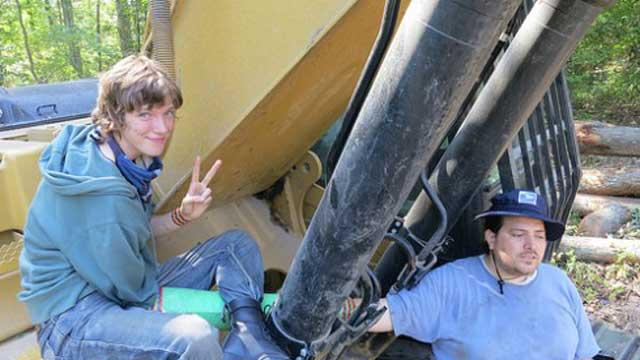
Meanwhile, in East Texas, a contingent of Tar Sands Blockaders maintains their vigil--now in its fifth week--to stop construction on the Gulf Coast extension of the controversial project.
The nonviolent blockaders have been met with pain compliance tactics, felony charges, a SLAPP suit which uses the language of "eco-terrorism" and what amounts to a police state surrounding their tree village in Winnsboro, Texas.
TransCanada, the multinational corporation behind the $7 billion Keystone XL pipeline, has hired local off-duty police as well as a private security to maintain their own occupation of the pipeline's easement in Winnsboro, Texas, where blockaders have been set up in a tree village since September.
Blockaders have been trying to negotiate for weeks with the on-site private security firm to arrange for food and water to be brought to activists occupying the trees.
But security hired by Michels Corporation, the company TransCanada contracted to construct the southern leg of the pipeline, refused to allow it. On Monday, October 15, blockaders stormed the easement in an attempt to resupply their friends in the trees.
Activists affiliated with the Tar Sands Blockade say they have seen it all the past few weeks. Two blockaders who locked themselves to construction equipment in East Texas - Shannon Bebe and Benjamin Franklin - were subjected to pepper spray, arm-twisting, chokeholds and multiple uses of Tasers to get them to unlock themselves.
Franklin, Bebe and others are now facing felony charges under the Texas criminal instruments law, the same law that was used against Occupy activists in Austin last December after police infiltrators gave protesters locking devices they used to block an entrance to the port of Houston.
According to the law, a "'criminal instrument' means anything - the possession, manufacture or sale of which is not otherwise an offense - that is specially designed, made or adapted for use in the commission of an offense."
TransCanada also slammed the blockaders with a Strategic Lawsuit Against Public Participation (SLAPP) last week, naming 19 individual defendants, three organizations and another six unidentified tree-sitters. The broad civil action seeks an injunction, declaratory relief and damages.
The suit also alleges the blockaders have engaged in acts of "eco-terrorism." According to the suit:
"Under the auspices of nonviolent direct action, the Defendants, all of whom are members of, affiliated with, or acting under the banner of the Tar Sands Blockade group, have engaged in acts of eco-terrorism through their coordinated, orchestrated and ongoing unlawful conduct and have trespassed on Keystone's property, have interfered with construction of Keystone's pipeline and/or threatened additional interference with construction of Keystone's pipeline in an attempt to deny Keystone use of Keystone's valid right of way."
According to the suit, TransCanada hired Greenwood Advisors to collect intelligence on Tar Sands Blockade. Eric Flatten, a staff consultant to Greenwood, works as an agent for TransCanada in its interactions with law enforcement agencies, according to the suit. Flatten provides many details of the Blockade's Livingston lockdown action in the suit.
However, Pipeline opponents' concerns transcend private property rights. The carbon loads that contribute to climate change over time are a key issue for the blockaders.
Meantime, the potential for immediate environmental and public health impacts have already been demonstrated in the unprecedented history of leaks and spills in Keystone's existing Midwestern link, which opened in 2010.
Incidents like the latest problem that turned up this week somewhere between Missouri and Illinois, forcing the temporary shut-down, only strengthened blockaders' resolve in Texas.
According to Blockade spokesman Ron Seifert, TransCanada also hired Tutela Security to police the tree village and make arrests of the tree-sitters should they decide to descend. TransCanada would not confirm the name of their private security firm.
"The [tree] village is still on the right of way, even though we got an additional easement to go around the tree village, and we've got constructible right of way that the tree village doesn't obstruct; but they're still criminally trespassing on that property," says David Dodson, a spokesman for the Keystone XL Gulf Coast segment.
The property Dodson is referring to is private land acquired by TransCanada through the threat of eminent domain. Many landowners in East Texas have come forward recently saying the corporation intimidated them into signing contractual agreements for their land.
In one recent court ruling, Texas landowner Julia Trigg Crawford, one of the few Texas landowners who never signed one of TransCanada's easement agreements, sought to challenge TransCanada's right to take a piece of her property by disputing their claim as a "common carrier" in court.
Common carrier status is granted by the Texas Railroad Commission, and allows corporations the power to seize private property by eminent domain. But in Texas, all TransCanada had to do to apply as a common carrier was simply fill out a government form for a permit, known as the T-4 form, and check a box labeled "common carrier."
Crawford's case was backed up by the Texas Rice Land v. Denbury Green decision in which the Texas Supreme Court ruled that the T-4 permit granted by the railroad commission does not conclusively establish eminent domain.
Dodson told Truthout that Michels' operators have standing orders to turn off their construction equipment when they see protesters approaching, in compliance with federal safety regulations. Dodson also said TransCanada does not direct local law enforcement, and has not directed off-duty officers to arrest tree-sitters. He said that the off-duty officers are making those arrests as deputized police officers.
Dodson also states that the officers who detained two New York Times reporters were hired security acting in their capacities as local police. "There have been a number of occasions where occupiers have represented themselves as journalists," Dodson said.
But a different picture of what is happening on the ground in Winnsboro is emerging from the very same "occupiers" Dodson claims aren't real journalists--and they have the documentation to prove it.
Lorenzo Serna, one of the independent journalists arrested by TransCanada's hired security, recorded video of a man in a bright orange vest driving an ATV giving orders to hired security during Monday's action. Serna was detained shortly after. It is not clear whether the man is giving orders to hired off-duty police officers or to private security.
The journalists were arrested after spending nearly a week embedded with blockaders on a 40-foot tall wall made of timber scaffolding. Charges against Serna and Elizabeth Arce were subsequently dropped after their arrest.
Serna told Truthout that a man climbed the timber wall to speak with him and Arce, and referred to himself as police; but later when he was asked if he was a sheriff, and asked which police department he was with, he replied, "I don't know."
In another incident, a Michels equipment operator is caught on camera dropping a tree perilously close to a blockader, who sat down in front of the feller buncher the man was operating.
"[The blockaders'] intent--it seems to me--is to approach unnoticed," Dodson told Huffington Post's Matt Sledge. "If that is the case, then I should have added that the allegation that there is a lack of supervision that is endangering the protestors is groundless."
Firedoglake activists recently mobilized to call the Wood County Sheriff's Department in troves. The office employs the off-duty police now working for TransCanada for $30 per hour to police blockaders in public uniform. "Officers have to take off-duty jobs to make enough money to survive," Wood County District Attorney's lead investigator Jerry Hirsch told an FDL activist.
The Wood County Sheriff's Department did not respond to a request for comment in time for the publication of this article.
3 WAYS TO SHOW YOUR SUPPORT



- Log in to post comments


